Choosing the China best High Contrast Golf Sunglasses supplier requires more than comparing price lists and product photographs. Golfers need reliable visual performance across bright fairways, shaded greens, and changing skies. High Contrast Golf Sunglasses should sharpen ball visibility without making grass textures appear unnaturally harsh. Lens tint, polarization, UV protection, optical clarity, frame stability, and ventilation all deserve careful review.
Dr. Gary Heiting, OD, a respected vision-care educator, states, “The best sunglasses are the ones you will wear consistently.” That practical idea matters on the course. A pair may offer impressive specifications, yet poor nose comfort can end its use after nine holes. A dependable Chinese supplier should provide lens samples, measured transmission data, impact information, and clear production records. Factory photographs are not enough. Ask for details.
Real testing reveals more than marketing language. Place the lenses over a white golf ball, then inspect it against bright grass and deep shadow. Check whether edges remain clear during a head turn. Test the frame during a walking round, not only inside a showroom. A good supplier should discuss replacement lenses, quality control, packaging, and communication honestly.
There is no perfect lens.
Some golfers prefer copper tones, while others dislike their warmer color. Polarization can reduce glare, but certain players may find digital screens harder to read. These limitations deserve attention. Even a careful review can miss inconsistent batches. Therefore, this guide examines supplier experience, customization ability, production reliability, and after-sales support before naming the strongest candidates for High Contrast Golf Sunglasses.
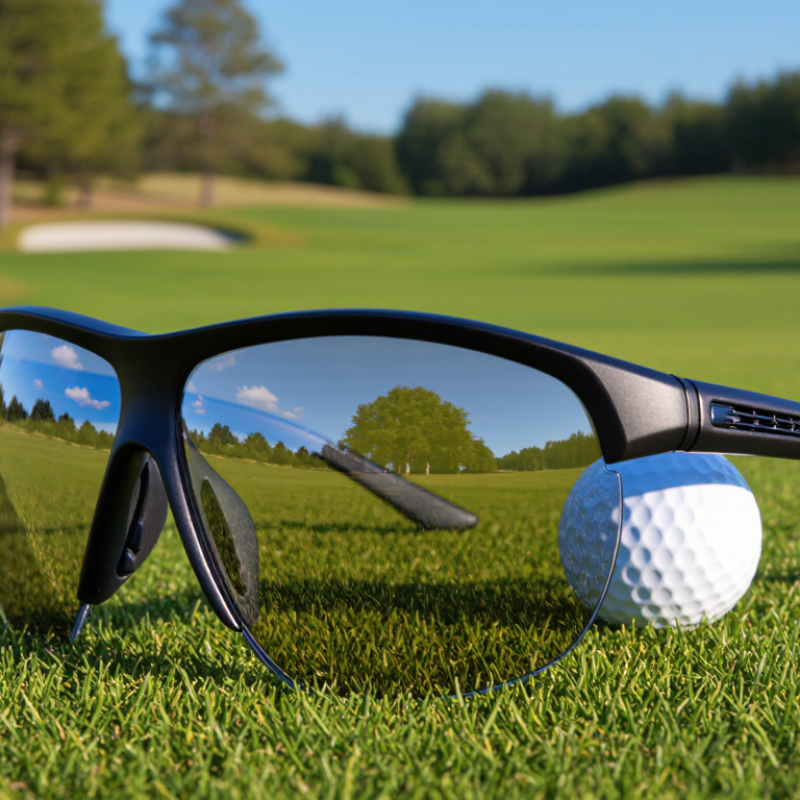
High contrast golf sunglasses help golfers separate a white ball from blue sky, pale grass, and distant trees.
Their lenses manage brightness while preserving useful color differences. This matters during drives, approach shots, and quick reads around the green.
The National Golf Foundation’s 2024 Golf Industry Report recorded 28.1 million on-course golfers in the United States during 2023.
That participation level reflects many hours spent judging small, moving targets outdoors.
The American Optometric Association recommends sunglasses blocking 99% to 100% of UVA and UVB radiation. High contrast alone is not enough.
Look for verified ultraviolet protection, comfortable coverage, and stable lenses that do not distort the ball’s flight. Amber, copper, or rose tints may make turf contours and white balls appear clearer.
However, tint performance varies with weather, eyesight, and personal color perception.
More contrast can sometimes make shadows look too harsh.
That is an overlooked problem.
Tips:
Test lenses beside a practice green before buying. Compare the ball against bright sky, rough, and shaded grass.
Check visibility after several swings, not one quick glance.
Polarized lenses can reduce reflected glare, but some golfers dislike their effect on screens or subtle surface textures.
A professional eye examination remains sensible, especially when headaches or delayed focus appear.
There is no universal “best” tint. Field experience still needs careful testing.
High-contrast golf sunglasses should make contours clearer, not simply darken the course. On a fairway, the useful test is immediate: can you separate grass, sand, and slope? Lens tint matters. Amber, copper, and rose filters often emphasize ball edges and ground changes. However, tint alone is not contrast control. Optical clarity, consistent polarization, and low distortion matter near the address position.
The World Health Organization’s Global Solar UV Index guidance recommends protection when the index reaches 3 or higher. That makes full UVA and UVB coverage a basic specification, not a luxury. Wraparound coverage can reduce side glare, although excessive curvature may distort peripheral vision. A reliable supplier should provide measured transmission data, not vague claims. Look for lens category, UV test results, impact performance, and frame dimensions. ANSI Z80.3 and ISO 12312-1 references can help buyers compare declared protection.
The National Golf Foundation’s 2023 industry report counted 28.1 million U.S. on-course golfers, showing a large and varied user base. One lens cannot suit every player. A morning round under gray clouds needs different contrast behavior from a bright, reflective afternoon. Fit, venting, and replaceable lenses are practical details. Still, claims about sharper vision deserve skepticism. Poor coatings can create distracting halos. A short outdoor trial is wiser than trusting a catalog photograph.
China offers many golf sunglasses suppliers, but product photos reveal little. The National Golf Foundation reported 26.6 million U.S. on-course golfers in 2023. That market demands stable optical performance, not only attractive pricing. Request lens samples for bright fairways, cloudy mornings, and shaded greens. Check contrast, color distortion, glare control, and frame comfort after several hours.
Ask each supplier for documented test results. Lens transmission should match the claimed category. UV protection must be verified through independent laboratory testing, not a handwritten specification sheet. For export sales, request compliance documents covering applicable eyewear safety requirements, including EN ISO 12312-1 where relevant. Review the testing laboratory, report date, sample code, and measured results. A certificate without traceable details is weak evidence.
Tips: Compare three suppliers using the same sample checklist. Inspect hinge alignment, nose-pad grip, lens edges, and packaging damage. Request a small pilot order before large production. Discuss defect limits, replacement terms, and inspection timing in writing. Ask how they control lens tint between production batches. Some suppliers answer slowly, which may signal poor support, but it is not conclusive. I would also measure samples personally, because supplier data can be accurate yet incomplete. Independent inspection costs money, but one inspection may prevent a larger inventory mistake.
Choosing a high-contrast golf sunglasses supplier requires more than a bright sample. A capable factory should document material checks, lens curvature, coating adhesion, and frame dimensions. Ask for production records, not promises. Lenses should be assessed for UV protection, optical clarity, impact resistance, and consistent light transmission. For golf, contrast enhancement must preserve natural green, white, and yellow ball colors. Overly dark lenses can reduce visibility on shaded fairways. That detail is often missed.
Reliable manufacturing follows controlled processes. Molds need inspection before mass production, while injection settings should be recorded for each batch. Operators should check hinge alignment, nose-pad stability, and lens seating during assembly. Random inspections are useful, but critical dimensions need defined sampling plans. Independent laboratory testing can support claims about UV performance and mechanical strength. Still, paperwork alone proves little. Factory visits and retained samples reveal more.
Customization may include lens tint, contrast curve, polarization, anti-reflective treatment, frame color, temple length, and packaging. A supplier should explain how each change affects cost, lead time, and performance. Small adjustments matter. Request prototypes under sunlight, cloud cover, and indoor lighting. Compare color perception, glare control, and comfort after several hours. One production lesson deserves honesty: the first sample may look perfect, yet fit poorly after repeated use. Revision is normal. Document every change, including disappointing ones, before approving a final batch.
| Evaluation Dimension | Recommended Specification or Requirement | Why It Matters for Golf | Verification or Customization Option |
|---|---|---|---|
| Lens light transmission | Category 2 lenses generally transmit 18%–43% of visible light; Category 3 lenses generally transmit 8%–18%. | Category 2 is suitable for many partly cloudy conditions, while Category 3 provides stronger glare reduction in bright sunlight. | Specify the target visible light transmission (VLT) percentage and request a tested lens-category report. |
| UV protection | UV400 protection should block ultraviolet radiation through approximately 400 nm, including UVA and UVB ranges. | Helps reduce ultraviolet exposure during long periods outdoors. | Request spectrophotometer results covering the 280–400 nm ultraviolet range. |
| High-contrast tint | Amber, rose, copper, or brown-based tints can improve visual separation between grass, terrain, and the ball; the final effect depends on lighting and spectral design. | Enhanced separation may help identify contours, landing areas, and the ball against green or blue backgrounds. | Choose a tint color, optical density, and spectral transmission curve; validate samples outdoors under intended playing conditions. |
| Polarization | Optional polarized lenses can reduce reflected glare from water, wet grass, sand, and vehicle surfaces. | Useful near water hazards and during bright conditions, although polarization may affect the visibility of some digital displays. | Specify polarization efficiency, commonly targeted at 95% or higher, and confirm display compatibility. |
| Optical quality | Lenses should have consistent power, minimal distortion, and uniform tint across the usable viewing area. | Consistent optics support clear visual tracking and reduce unnecessary eye strain. | Request optical-power, prism, distortion, and tint-uniformity inspection records based on the selected market standard. |
| Applicable product standards | Common reference standards include EN ISO 12312-1 for general-purpose sunglasses, ANSI Z80.3 for nonprescription sunglasses, and AS/NZS 1067.1 for sunglasses and fashion spectacles. | A defined standard provides test criteria for optical performance, transmittance, marking, and selected safety characteristics. | Select the destination-market standard before sampling and request a current third-party test report. |
| Impact resistance | Use impact-resistant lens materials such as polycarbonate or Trivex-type materials when higher impact performance is required. | Improves protection against accidental drops, fragments, and routine outdoor handling. | Define the required impact test and product classification; do not treat ordinary sunglasses as certified protective eyewear unless separately tested. |
| Lens materials | Polycarbonate is lightweight and impact-resistant; nylon and CR-39-type materials can provide different optical, weight, and cost balances. | Material selection affects weight, durability, optical clarity, and resistance to outdoor use. | Customize material, thickness, base curve, lens weight, and surface finish according to the frame design. |
| Anti-reflective coating | An anti-reflective coating on the rear lens surface can reduce reflected light entering from behind the wearer. | Can improve comfort when sunlight comes from behind or at an angle. | Specify front or rear coating, target reflectance, coating adhesion, abrasion resistance, and cleaning durability. |
| Hydrophobic and oleophobic finish | Optional surface treatment can improve resistance to water spots, fingerprints, and light contamination. | Helps maintain visibility during humid, wet, or dusty outdoor play. | Request contact-angle, abrasion, and repeated-cleaning test data for the selected coating. |
| Frame materials | Common options include injected nylon, polycarbonate, acetate, stainless steel, and lightweight alloy constructions. | Material choice influences durability, flexibility, weight, corrosion resistance, and comfort. | Customize material, surface texture, color, finish, hinge design, and component compatibility. |
| Fit and coverage | A wraparound or semi-wrap design can increase side coverage; lens curvature must be matched with suitable optical and frame parameters. | Better coverage can reduce peripheral glare and wind exposure without obstructing the golfer’s field of view. | Define eye size, bridge width, temple length, base curve, pantoscopic angle, and adjustable nose-pad dimensions. |
| Ventilation and anti-fog design | Ventilated frame details or an anti-fog treatment may be used where humidity and temperature changes are expected. | Helps reduce fogging during walking, cart travel, or changing weather conditions. | Customize vent locations, vent size, coating type, and anti-fog durability after repeated cleaning. |
| Color and finish customization | Available options may include solid tint, gradient tint, mirror finish, translucent frame colors, matte finish, or gloss finish. | Allows the product appearance and visual performance to be aligned with the target market. | Provide color references, surface-finish requirements, acceptable color tolerance, and sample approval procedures. |
| Marking and packaging | Packaging should identify lens category, UV protection claims, care instructions, applicable warnings, and traceability information where required. | Clear information supports correct use and helps meet destination-market labeling requirements. | Customize hangtags, cartons, cases, cleaning cloths, instruction cards, barcode placement, and language versions. |
| Quality-control process | A controlled process should include incoming-material inspection, in-process checks, final optical inspection, coating inspection, dimensional checks, and packaging verification. | Consistent inspection reduces variation between samples and production batches. | Agree on an inspection plan, acceptable quality limits, sampling level, defect classification, corrective-action process, and pre-shipment inspection. |
Note: The recommended values are general product-development references. Final requirements should be confirmed against the regulations and testing standards of the intended sales market.
Selecting a China supplier requires more than comparing catalog prices. The National Golf Foundation reported 28.6 million on-course golfers in the United States during 2023. That participation level raises expectations for comfortable, durable eyewear. A capable supplier should provide lens test reports, UV400 verification, impact testing, and clear production tolerances. Ask for samples from different batches, not only one attractive prototype.
High-contrast lenses should improve ball visibility against grass, clouds, and changing shadows.
Request measured visible light transmission, color-filter data, and polarization performance. Marketing claims alone are weak evidence. Grand View Research estimated the global sports sunglasses market at about USD 4.2 billion in 2023, showing strong demand but also intense competition. The supplier’s laboratory process matters more than polished product photographs.
Inspect hinge movement, frame recovery, nose-pad grip, and lens alignment by hand. Small defects become uncomfortable during a four-hour round. Confirm compliance documentation against relevant sunglass standards, such as ISO 12312-1, and verify that reports match the exact model. Factory audits, traceable materials, and written inspection records improve reliability. Still, no supplier is perfect. I would test samples in bright fairway light, cloudy conditions, and late-afternoon glare before placing a large order. The first sample may pass visually and fail after repeated cleaning.
They help separate a white ball from blue sky, pale grass, and distant trees. This can improve visibility during drives and approach shots. Shadows may look too harsh.
Amber, copper, and rose tints may make turf contours and white balls clearer. Performance changes with weather, eyesight, and personal color perception. There is no universal best tint.
Choose sunglasses blocking 99% to 100% of UVA and UVB radiation. Ask for verified test results, not only printed claims. Contrast alone is insufficient.
Compare a ball against bright sky, rough, and shaded grass near a practice green. Wear the lenses through several swings and different viewing angles. One quick glance proves little.
Polarized lenses can reduce reflected glare from bright surfaces. Some golfers dislike their effect on screens or subtle surface textures. Personal testing matters.
Request lens samples for sunny fairways, cloudy mornings, and shaded greens. Ask for transmission, color-filter, polarization, UV, and impact test records. Photographs are weak evidence.
Review the laboratory name, report date, sample code, and measured results. Confirm that each report matches the exact sunglass model. A certificate without traceable details remains weak evidence.
Check hinge movement, nose-pad grip, lens alignment, lens edges, and packaging. Request samples from multiple production batches. Small defects become uncomfortable.
A small order can reveal tint variation, cleaning damage, and frame weaknesses. Write defect limits, replacement terms, and inspection timing clearly. Supplier data may be accurate yet incomplete.
High Contrast Golf Sunglasses are designed to help golfers see more clearly in changing outdoor conditions by improving visual definition between the ball, fairway, hazards, and surrounding landscape. Their key features may include specialized contrast-enhancing lenses, glare reduction, UV protection, lightweight frames, secure fitting, and comfortable designs suitable for extended wear. These benefits can support better visual focus without replacing good technique or proper eye care.
When evaluating a Chinese golf sunglasses supplier, buyers should examine product quality, lens performance, manufacturing consistency, material safety, inspection procedures, and production capacity. It is also important to confirm customization options, such as lens colors, frame styles, logos, packaging, and order quantities. The best supplier should communicate clearly, provide reliable samples, maintain consistent standards, and offer transparent support from design to delivery. A careful comparison of technical capabilities, quality control, customization flexibility, and service can help buyers select a dependable partner for High Contrast Golf Sunglasses.