4.7★ / 9,201 Reviews · 100K+ Customers · TIME Best Invention · Fast & Free Shipping

Finding China’s top Instant Tint Sunglasses manufacturer requires more than comparing factory photos or attractive prices. A reliable partner should demonstrate practical experience, stable production, and clear product knowledge. The best manufacturers explain lens materials, tint response, UV protection, frame options, and testing procedures without hiding limitations. This matters when sunglasses must perform under bright streets, changing weather, and daily outdoor use.
China has a mature eyewear supply chain, supported by specialized lens factories, frame workshops, coating suppliers, and quality-control teams. Experienced manufacturers can often manage private labeling, small design changes, packaging, and bulk orders. They may also provide samples before production begins. Look closely at sample consistency. Check hinge movement, lens clarity, color transition, surface coating, and printed markings. Small details reveal factory discipline.
No supplier is perfect. Some companies show excellent samples but struggle with large orders. Others offer fast communication but provide weak technical documents. That gap deserves attention. Buyers should request test reports, production photographs, inspection records, and written specifications. Independent verification remains valuable. It can prevent expensive misunderstandings later.
A strong manufacturer also communicates responsibly. Claims about tint speed should reflect real testing conditions, not only marketing language. Temperature, light intensity, lens color, and storage can affect performance. Ask precise questions and record the answers. A trustworthy supplier welcomes reasonable checks. That confidence is earned through repeatable quality, transparent service, and consistent delivery. This guide examines the practical signs that separate a capable Chinese Instant Tint Sunglasses manufacturer from a supplier that only looks impressive online.
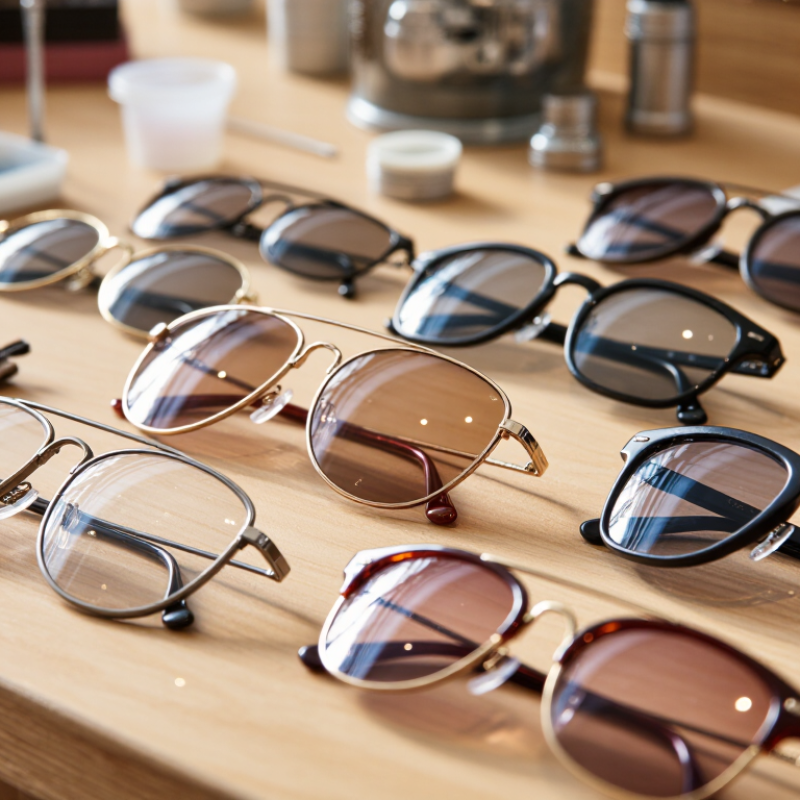
Instant-tint sunglasses use photochromic molecules that react to ultraviolet light. When UV exposure rises, the lenses gradually become darker. Many advanced lenses reach a noticeable tint within 30–60 seconds. That is fast, but it is not instant in the literal sense. Shade depth depends on UV intensity, temperature, lens material, and coating quality.
A reliable manufacturer tests this response with calibrated UV lamps and outdoor exposure. Technicians record tint changes at 10-second intervals. They also measure optical clarity, color consistency, and fade-back time. In real use, bright summer sunlight may trigger a quicker response. Cold weather can slow the reaction. Inside a vehicle, windscreen filtering may reduce activation because much UV light is blocked.
The best production process controls dye distribution across every lens. Small differences can create uneven shading, especially near the edges. That detail is easy to miss. Manufacturers should inspect samples from different batches, not only one finished pair. A 30–60 second claim also needs clear testing conditions. Without them, the number sounds stronger than it is. From a buyer’s perspective, ask for response data, temperature ranges, and durability results. A dependable supplier should provide practical evidence rather than polished promises. The technology is impressive, but expectations still need careful calibration.
| Evaluation Dimension | Typical Technical Data | What Defines an Instant-Tint Product | Recommended Verification Method | Buyer Relevance |
|---|---|---|---|---|
| Photochromic activation response | Visible darkening generally begins within seconds after exposure to ultraviolet radiation. A practical instant-tint target is noticeable tint development within 30–60 seconds. | Fast and visibly progressive tinting without abrupt color changes, provided that the lenses are exposed to suitable UV intensity. | Measure luminous transmittance at fixed intervals, such as 0, 15, 30, 45, and 60 seconds, using a calibrated spectrophotometer. | Helps users adapt more quickly when moving from indoor or shaded areas into sunlight. |
| Fading or clearing response | Clearing normally takes longer than darkening and can range from several minutes to longer depending on lens material, temperature, tint level, and product formulation. | A high-quality lens should return toward its clear state consistently rather than retaining an uneven residual tint. | Record luminous transmittance after removal from UV exposure at 1, 3, 5, 10, and 15-minute intervals. | Important for users who frequently move between outdoor and indoor environments. |
| UV activation requirement | Photochromic molecules are primarily activated by ultraviolet radiation. Behind a vehicle windshield, activation may be reduced because many windshields filter a substantial amount of UV. | Performance claims should specify whether testing is performed in direct UV exposure, simulated sunlight, or behind automotive glass. | Test under a stated UV source and document irradiance, exposure distance, temperature, and windshield condition when applicable. | Prevents incorrect expectations about darkening performance while driving. |
| Dark-state luminous transmittance | Common sun-lens categories include Category 2 and Category 3. Category 3 lenses typically transmit approximately 8%–18% of visible light under the relevant standard conditions. | An instant-tint lens should reach its specified dark-state range within the stated test time, not merely become slightly darker. | Measure luminous transmittance after the lens reaches thermal and photochemical equilibrium. | Indicates practical glare reduction in bright outdoor conditions. |
| Clear-state luminous transmittance | Clear-state transmission varies by lens material, coatings, prescription, and residual tint. It is commonly higher than the dark-state transmission. | The clear state should provide adequate indoor visibility and consistent color appearance across the lens. | Measure luminous transmittance and chromaticity before UV exposure after the lens has fully cleared. | Supports comfortable indoor wear and reduces the need to switch glasses frequently. |
| Temperature sensitivity | Photochromic performance is temperature-dependent. Many lenses darken more slowly or reach a lighter maximum tint in hot conditions, while cold conditions may slow clearing. | Performance data should include the test temperature instead of presenting one response time as valid for every climate. | Repeat activation and clearing tests at controlled temperatures, such as 10°C, 23°C, and 35°C. | Relevant for outdoor workers, travelers, and customers in hot or cold regions. |
| Color uniformity | The tint should remain visually consistent across the lens area when the lens material, coating, and photochromic layer are properly controlled. | No obvious patches, streaks, edge-to-center differences, or mismatched left and right lenses should appear during activation. | Inspect both lenses under uniform UV illumination and compare color and transmittance at multiple points. | Improves appearance, optical comfort, and perceived manufacturing quality. |
| UV protection | UV protection is a separate performance claim from photochromic speed. The finished lens should be tested for UVA and UVB transmission according to the applicable market standard. | Claims should be supported by test results for the complete finished lens, including material and coatings. | Use an accredited optical laboratory to measure spectral transmittance across the ultraviolet range. | Provides objective evidence for outdoor eye-protection claims. |
| Optical material compatibility | Photochromic lenses may be produced using materials such as mineral glass, CR-39-type resin, polycarbonate, and high-index plastics. Response varies by formulation and construction. | The same response-time claim should not automatically be applied to every material, prescription power, thickness, or coating combination. | Test representative samples from each material, power range, coating system, and lens design. | Helps buyers select a consistent product for different prescription and safety requirements. |
| Abrasion and coating durability | Hard coatings and anti-reflective coatings can improve surface durability and optical transmission, but they do not eliminate the need for proper cleaning and handling. | The photochromic performance should remain within the supplier’s specification after applicable durability testing. | Perform coating adhesion, abrasion, environmental aging, and post-aging photochromic response tests. | Supports longer service life and fewer appearance-related complaints. |
| Compliance and documentation | Requirements vary by destination market. Common areas include optical quality, impact resistance where applicable, UV transmission, labeling, and product traceability. | A reliable supplier should provide batch information, technical specifications, test reports, and a clearly defined inspection standard. | Review reports from competent or accredited laboratories and confirm that samples match the shipped production. | Reduces regulatory, quality-control, and shipment risks. |
| Recommended acceptance benchmark | For an “instant-tint” claim, define measurable limits for activation time, final dark-state transmission, clearing behavior, color uniformity, UV performance, and temperature conditions. | The phrase “30–60 seconds” should identify the exact measurement point, light source, temperature, lens material, and percentage change in transmittance. | Approve production only after a documented sample test meets the agreed specification. | Turns a marketing description into a repeatable and comparable purchasing standard. |
Note: Photochromic response times are typical technical ranges rather than universal guarantees. Actual performance depends on UV intensity, temperature, lens material, prescription, coatings, aging, and the testing method used.
They use lenses that change darkness when exposed to ultraviolet light. Many reach a noticeable tint within 30–60 seconds. Not literally instant. The speed depends on sunlight, temperature, lens material, and coating quality.
Photochromic molecules react automatically when ultraviolet light reaches them. They darken outdoors and become clearer when UV exposure decreases. The process needs no battery. Cold weather may slow the change. Strong heat can limit the darkest shade.
Not always. Many windscreens block significant ultraviolet light. The lenses may stay relatively clear, even under bright dashboard conditions. Testing should include outdoor sunlight, indoor lighting, and vehicle use. Real driving may differ from laboratory results.
Electrochromic lenses use electrical current to control tint through layered materials. A button, sensor, or connected control can select the shade. Their response may feel more predictable during changing sunlight. However, they need power, sealing, and electrical testing. Battery life remains a practical weakness.
Testing should measure tint response at regular intervals, such as every ten seconds. It should also check optical clarity, color consistency, and fade-back time. Samples from different production batches matter. One finished pair proves very little. Small variations can appear near lens edges.
ISO 12312-1 addresses general sunglasses performance, including optical quality and mechanical safety. UV400 generally indicates protection against ultraviolet radiation below 400 nanometers. A printed label is not enough. Request recent reports from an accredited laboratory. Check the lens model and test date.
Examine several pairs from different cartons. Hold each lens under direct sunlight, shade, and indoor lighting. Look for darker edges, streaks, or mismatched left and right lenses. Retained samples and periodic retesting improve traceability. A single sample can mislead.
Ask for measured transition times and testing temperatures. Request durability results after repeated tint cycles. Confirm UV transmittance for the finished lenses, not only raw materials. Review batch numbers and pre-shipment inspection records. The evidence may still feel incomplete. That deserves a second question.
Instant Tint Sunglasses are designed to adapt to changing light conditions by adjusting lens darkness quickly and smoothly. Photochromic lenses typically respond to UV exposure and may reach a noticeable tint within 30–60 seconds, while electrochromic lenses use an electrical system to provide more controlled tint levels. Buyers should understand the differences in response speed, power requirements, temperature performance, and transition consistency before selecting a product.
When evaluating China-based manufacturers, buyers should request documented testing for ISO 12312-1 and UV400 performance, along with clear information about lens materials, optical clarity, tint range, activation cycles, durability, and warranty support. Factory data such as production capacity, quality-control procedures, sample consistency, test reports, and traceability can help identify a reliable supplier. The strongest manufacturers combine fast tint transitions with comfortable vision, stable long-term performance, and transparent technical documentation.
