4.7★ / 9,201 Reviews · 100K+ Customers · TIME Best Invention · Fast & Free Shipping

Choosing Electrochromic Sunglasses for global markets requires more than comparing lens colors or retail prices. Buyers must examine optical performance, switching speed, battery design, durability, and regional compliance. The opportunity is expanding. Grand View Research identifies strong growth across the electrochromic glass market, while IDTechEx reports continued investment in smart eyewear and adaptive optical technologies. These reports indicate momentum, but they do not guarantee product quality. No lens is perfect.
Professor Claes-Göran Granqvist, a leading electrochromics researcher, has described the field as “a multidisciplinary field.” That observation matters for sunglasses. A reliable product combines materials science, electronics, optics, mechanical design, and user safety. The World Health Organization links excessive ultraviolet exposure with cataracts and other eye damage. Therefore, buyers should verify certified UV protection, not assume adaptive tinting provides it. Electrochromic darkening and UV filtering are related, but they are not identical functions.
This guide evaluates products through a practical global-buying lens. It considers switching performance under bright sunlight, indoor readability, charging behavior, temperature resistance, and hinge durability. ISO 12312-1 and relevant regional standards should also be reviewed before import or distribution. Ask for independent test reports. Request sample units. Test them beside a window at noon. Small weaknesses become obvious there. A glossy specification sheet may hide them. Product claims can also vary between markets, so documentation deserves careful scrutiny. The best choice balances comfort, verified protection, service support, and realistic ownership costs. Sometimes, a simpler lens is the wiser purchase.
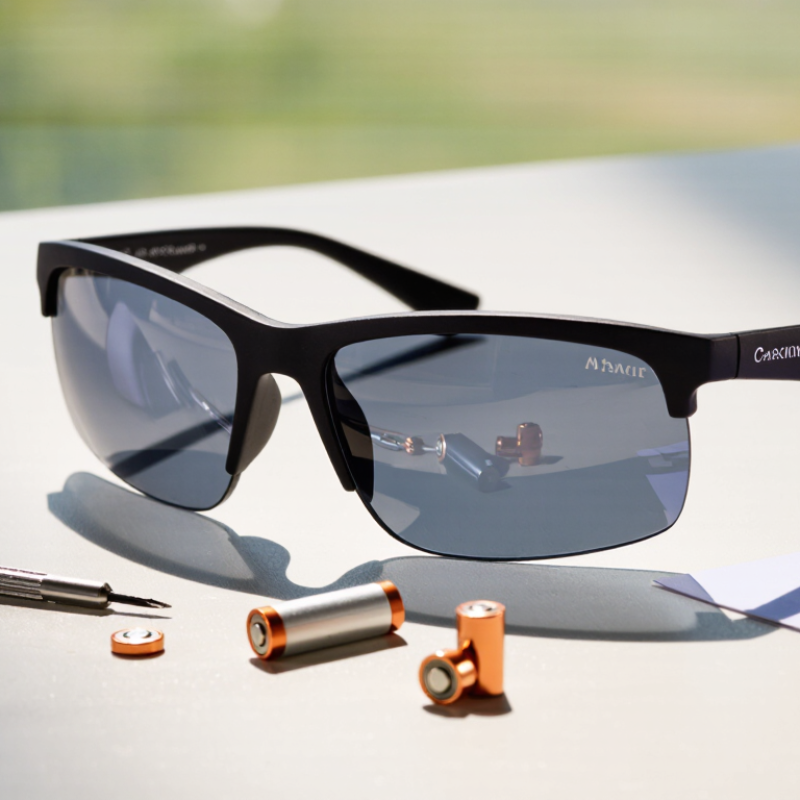
Electrochromic sunglasses use lenses that change darkness when a small electric current moves through special optical layers. Unlike ordinary polarized lenses, they do not rely only on fixed tint. A switch, button, or light sensor controls the adjustment. When the lens receives power, ions move between layers and alter how much visible light passes through. The lens becomes darker, then returns to a lighter state when the voltage changes.
For global buyers, the practical details matter. Check whether the lens blocks ultraviolet radiation across the full UV range, not only visible brightness. Ask for test reports, optical clarity data, and battery information. A reliable model should show its darkest and lightest levels clearly. Response time also deserves attention. Some lenses change in seconds, while others react more slowly in cold weather. That difference can matter when leaving a dim vehicle for bright sunlight.
Fit the frame carefully. A poor seal may allow side glare, especially during driving or outdoor work. Confirm charging methods, replacement parts, warranty coverage, and user instructions in your market. Do not assume one sensor setting suits every face or climate. In my view, buyers should test the controls with gloves and wet fingers, even if the product looks simple. The technology is useful, but not magic. Some advertised performance may weaken after repeated charging, and that possibility deserves honest questions before purchase.
| Evaluation Dimension | What It Means | Typical Technical Information | What Global Buyers Should Check | Why It Matters |
|---|---|---|---|---|
| Operating Principle | Electrochromic lenses change their light absorption when a small electrical voltage moves ions between electrochromic material layers. | The lens normally contains transparent electrodes, electrochromic layers, an ion-conducting electrolyte and protective substrates. | Request a product diagram or technical description confirming that the lens is genuinely electronically tintable. | This distinguishes electrochromic sunglasses from ordinary fixed-tint or photochromic lenses. |
| Tint Control | The wearer can select the lens shade through a button, touch control, remote control or connected device, depending on the design. | Many products provide multiple tint levels rather than continuous manual control. The exact number of levels varies by model. | Confirm the number of settings, control location, accidental-activation protection and whether controls work while wearing gloves. | Multiple settings are useful when moving between indoor areas, streets, driving conditions and bright outdoor environments. |
| Visible Light Transmission | Visible Light Transmission, or VLT, indicates how much visible light passes through the lens. Higher VLT means a lighter lens. | Electrochromic products commonly offer a lighter state and one or more darker states; the actual VLT range is model-specific and must be measured by the manufacturer. | Ask for measured VLT values for every tint setting, not only a marketing description such as “light” or “dark.” | VLT helps buyers match the lens to local sunlight, driving use, sport use and indoor-outdoor transitions. |
| Switching Speed | Switching speed is the time required for the lens to move from one tint state to another. | Electrochromic switching is generally measured in seconds or longer, and performance can vary with lens size, temperature, battery condition and the size of the tint change. | Request separate darkening and lightening times at defined temperatures and for a specified lens size. | Published test conditions make switching-speed claims easier to compare across suppliers and climates. |
| Temperature Performance | Electrochromic reactions can change speed and efficiency in hot or cold environments. | Low temperatures may slow switching, while high temperatures can affect battery life, materials and long-term durability. | Check the operating-temperature range, storage-temperature range and any test results for the intended sales regions. | Products sold globally may experience very different climates, from cold winters to hot and humid conditions. |
| UV Protection | UV protection reduces exposure to ultraviolet radiation. It is separate from the electronic tinting function. | Quality sunglasses should block both UVA and UVB wavelengths, but protection must be verified from lens test data rather than inferred from darkness. | Request UV transmission or blocking test results and confirm compliance with the regulations required in the target market. | A darker lens is not automatically safer if it does not provide adequate UV protection. |
| Polarization | Polarization reduces glare from reflective surfaces such as water, snow, glass and wet roads. | Electrochromic tinting and polarization are different optical functions. A product may include one, both or neither. | Confirm whether polarization is built into the lens and ask about glare performance, optical quality and viewing compatibility with displays. | Polarization can improve comfort for driving, boating, skiing and other high-glare activities. |
| Power Source | The electronics require power to change the lens state and operate the control system. | Designs may use a rechargeable battery, replaceable battery or another integrated power arrangement. Many electrochromic systems use little or no power while holding a stable state, but this depends on the design. | Check charging method, charging time, expected operating cycles, battery replacement options and performance when the battery is empty. | Power management affects convenience, shipping requirements, maintenance and reliability during travel. |
| Fail-Safe Behavior | This describes the lens state and user access when power is unavailable or the control system malfunctions. | Some products remain in their last state, while others return to a predefined state. Behavior is product-specific. | Ask whether the lens can still be worn safely without power and whether manual override or emergency control is available. | A predictable fail-safe mode is important for driving, outdoor work and long-distance travel. |
| Optical Quality | Optical quality covers clarity, distortion, color consistency and visual comfort across the lens. | Lens curvature, tint uniformity, coatings and the placement of electronic components can affect visual performance. | Request optical distortion results, tint-uniformity data, color information and samples for visual inspection. | Good electronic functionality does not compensate for blurry vision, uneven tint or distracting color shifts. |
| Impact and Scratch Resistance | The lens and frame should withstand normal use, handling and foreseeable impacts. | Performance depends on the lens substrate, coatings, frame construction and the presence of embedded electronic parts. | Check impact-resistance testing, scratch-resistance testing, hinge durability and the recommended cleaning method. | Durability affects warranty rates, safety and total ownership cost. |
| Water and Dust Resistance | Electronic sunglasses need protection from rain, sweat, dust and cleaning exposure. | Water and dust resistance should be stated using an applicable enclosure or product test rating. A rating is not the same as unlimited waterproofing. | Confirm the claimed rating, test conditions, charging-port protection and restrictions on swimming or submersion. | Outdoor users and international travelers may encounter moisture and dust frequently. |
| Frame Fit and Coverage | Fit determines comfort, stability and how much stray light reaches the eyes. | Important measurements include lens width, bridge width, temple length, lens height and face-form compatibility. | Provide size charts, adjustable nose pads or other fit options, and confirm compatibility with prescription requirements if relevant. | A well-fitting frame improves comfort and helps the lens perform consistently in bright conditions. |
| Prescription Compatibility | Some electrochromic sunglasses can be made with prescription lenses, while others use fixed optical modules. | Compatibility depends on lens thickness, curvature, prescription range, electronics placement and manufacturing method. | Confirm supported sphere, cylinder, axis, pupillary distance, prism and progressive-lens options before ordering. | Prescription limitations can significantly reduce the usable market for a product. |
| International Compliance | Sunglasses and integrated electronics may be subject to different optical, electrical, radio and chemical requirements. | Requirements vary by destination and may cover UV performance, impact resistance, battery transport, electromagnetic compatibility and restricted substances. | Identify the destination-market standards, technical files, declarations and test reports required for import and sale. | Compliance documentation reduces customs delays, marketplace restrictions and product-liability risks. |
| Shipping and Battery Handling | Products containing lithium batteries may have special packaging, labeling and transport requirements. | Shipping rules depend on battery chemistry, watt-hour rating, whether the battery is installed and the transport method. | Request battery specifications, transport documents, packaging instructions and procedures for damaged or swollen batteries. | Correct battery documentation helps prevent shipment rejection and supports safer international logistics. |
| Warranty and Serviceability | Electronic sunglasses combine optical, mechanical and electronic components, so service policies are important. | Common service issues may involve battery aging, charging faults, control failure, coating damage or frame breakage. | Compare warranty duration, covered components, replacement-lens availability, repair locations and spare-part lead times. | Reliable after-sales support lowers the long-term cost for distributors and end users. |
| Recommended Use Case | The best configuration depends on the user’s environment and activity. | Driving may prioritize glare control and optical clarity; sports may prioritize impact resistance and secure fit; travel may prioritize battery life and charging convenience. | Define the primary activity, expected brightness, climate, prescription needs and frequency of indoor-outdoor transitions. | A use-case-first approach prevents buyers from paying for features that do not solve their actual needs. |
They use electric current to change lens darkness. Ions move between optical layers. A button, switch, or sensor controls the tint.
Power makes the lenses darker by changing light transmission. Lower voltage returns them to a lighter state. The process may take several seconds.
No. Electrochromic tinting and polarization perform different jobs. Tint controls overall brightness. Polarization can reduce reflected glare from roads, water, or snow. Confirm both features before buying.
Look for documented protection across the full ultraviolet range. Do not rely only on visible darkness. Request independent test results showing high UVA and UVB blocking. Dark lenses can still offer weak protection.
Tropical areas need strong UV protection and heat resistance. Snowy and coastal areas need effective glare reduction. Humid regions need well-sealed frames. Cold weather may slow the tint response.
Test the glasses near a bright window and under cloudy skies. Try them when moving from a dim room to bright pavement. Check performance at realistic temperatures. Laboratory results may not match daily use.
Check lens weight, bridge pressure, temple grip, and distortion. Wear the frame for thirty minutes. A quick fitting can mislead you. Fit varies across faces.
Ask about switching cycles, humidity exposure, temperature changes, and hinge testing. Check battery life, charging methods, replacement parts, and warranty terms. Keep fingerprints and coastal moisture away when possible. High cycle claims are not complete proof. I learned that late.
Electrochromic Sunglasses use electrically controlled lenses that adjust their tint in response to changing light conditions, helping users move comfortably between bright outdoor areas, offices, vehicles, and low-light environments. For global buyers, the ideal choice depends on climate, UV exposure, humidity, temperature changes, and local usage habits. Important features include tint range, switching speed, optical clarity, UV protection, battery life, charging options, frame comfort, and resistance to scratches, moisture, and impact.
Buyers should compare lens performance in realistic conditions and assess long-term durability through product testing and warranty information. It is also essential to check applicable safety, optical, electronic, and environmental certifications for the destination market. When selecting suppliers, evaluate production consistency, customization capabilities, minimum order quantities, transparent pricing, lead times, quality-control procedures, and communication efficiency. Reliable after-sales support, replacement policies, technical documentation, and spare-part availability can significantly reduce operational risks and improve customer satisfaction across different regions.