China’s smart-eyewear market is moving beyond novelty. Smart Audio Sunglasses now combine open-ear speakers, microphones, and everyday frame design. Yet choosing a manufacturer takes more than comparing product photos. Buyers need to examine sound quality, battery life, Bluetooth performance, frame comfort, and support for samples or custom specifications.
Sound expert Julian Treasure has said, “We are losing our listening.” His warning offers a useful lens for evaluating audio eyewear: sound should be clear without drowning out the world around the wearer. In practice, that means checking how voices sound on a noisy street, whether nearby people can hear audio leakage, and how the frames feel after an hour. Small details matter.
This guide explores China’s top Smart Audio Sunglasses manufacturers and the differences behind their product claims. It considers design capabilities, manufacturing experience, testing practices, and communication with buyers. Public specifications can help narrow a shortlist, but they cannot replace hands-on sample testing. A polished product page is not proof of consistent production. Even a careful checklist can miss things. Hinge durability, lens options, and after-sales response deserve attention too. The goal is not to name a universal winner, but to help readers ask sharper questions and compare suppliers with evidence rather than promises.
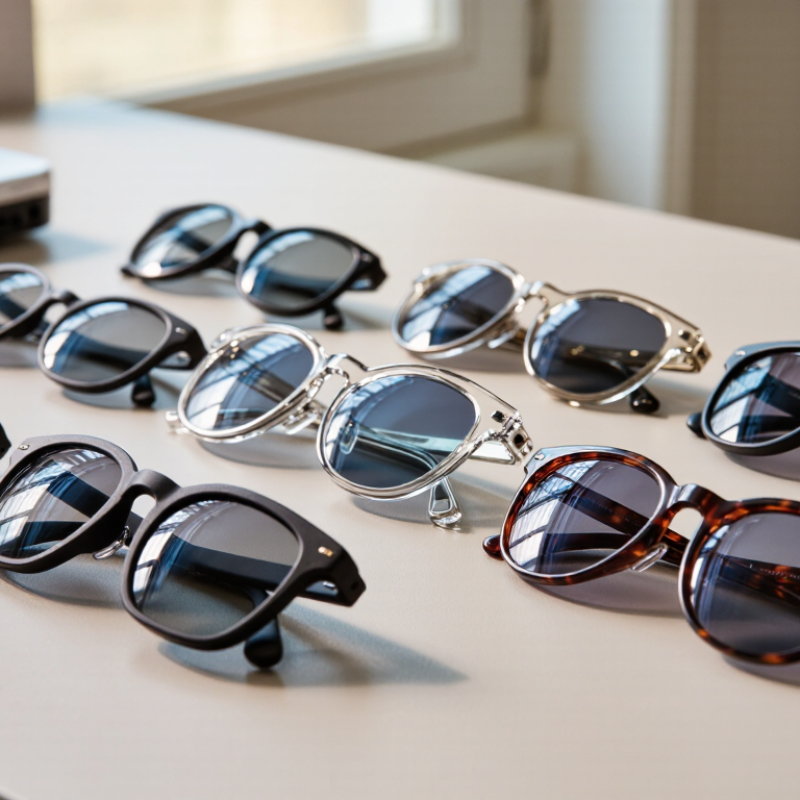
China Top Smart Audio Sunglasses Manufacturers?
Smart audio sunglasses place compact speakers near the ears, leaving the ear canals uncovered. Users can hear calls or music while remaining aware of nearby sounds. Open-ear audio is not private, though; people close by may hear some playback.
Microphones capture speech for calls and voice commands. Their performance can change with wind, traffic, and microphone placement. Connectivity usually relies on Bluetooth, linking the glasses to a phone for audio and controls. Check supported devices, connection stability, battery life, and charging details. Small components still need careful testing.
When comparing manufacturers in China, ask for clear specifications and sample units. Try calls both indoors and outdoors. Listen for sound leakage and inspect hinge movement, frame comfort, and control response. One test is not enough; real-world results can vary.
Tips: Wear the glasses for a full hour. Check fit, call clarity, and audio leakage in a quiet room and on a breezy street.
China’s smart audio sunglasses supply base includes OEM factories, ODM design teams, and component-focused assemblers. Their capabilities differ. Some suppliers work from a buyer’s drawings and specifications, while others offer frame designs, acoustic layouts, and companion app integration.
A practical product review starts with the temples. Check how speakers sit near the ears, whether microphone openings remain clear, and how the hinges feel after repeated opening. Ask for sample units, a component list, and details of battery, charging, and firmware testing. Small differences matter. A frame can look polished yet feel heavy after an hour. That trade-off deserves attention.
ODM partners may help refine frame geometry, packaging, and production tooling; OEM partners usually follow a defined design more closely. Neither label guarantees quality. Request a pilot run and inspect audio consistency, button response, charging contacts, and fit across several face shapes. Confirm who controls tooling files and software revisions. Supplier documents can be incomplete, and I would not treat a polished sample as proof of stable production. Real confidence comes from repeatable checks on units made under ordinary factory conditions.
For China’s smart audio sunglasses manufacturers, Bluetooth 5.2 is a useful starting benchmark, not a performance guarantee. The version introduced LE Isochronous Channels, which support synchronized audio delivery to multiple receivers. Buyers should ask whether the product actually implements LE Audio; a Bluetooth 5.2 label alone does not confirm it. Check the connection in a busy street, where crowded 2.4 GHz signals can expose weak antenna design.
The LC3 codec is another key measure. Bluetooth SIG’s LC3 technical materials report comparable perceived audio quality at about half the bitrate of the Subband Codec (SBC) in tested conditions. Lower bitrate can help reduce transmission demands, but it does not automatically extend battery life or improve sound. Open-ear speakers, frame vibration, wind, and microphone placement still shape what listeners hear. Small fit differences matter.
Tips: Request a live demo with the frames worn outdoors. Compare speech clarity at the same volume, then test calls with light wind. Ask for documented LE Audio and LC3 support, plus measured battery life under a stated test setup. If a specification sheet omits test conditions, treat the number cautiously; I would, too.
Battery runtime is best compared under the same conditions: continuous music at 50% volume, with calls tested separately. Record playback time until shutdown, then repeat with Bluetooth calling enabled. A claimed “all-day” runtime can shrink during frequent calls. Small detail, big difference. Counterpoint Research reported global smart-glasses shipments grew 210% year over year in 2024, but shipment growth does not prove longer battery life or better audio.
For water resistance, IPX4 means protection against splashing water from any direction under IEC 60529; it does not mean the glasses can be submerged. A brief drizzle and a heavy workout are different tests. Compare products by checking whether their documentation states an IP rating, rather than relying on words such as “sweatproof.” Fit and microphone placement matter, too. A loose frame may shift when the wearer moves.
Call quality should be tested outdoors and in a quiet room, with speech intelligibility noted at both ends. ITU-T Recommendation P.800 describes subjective listening tests using a Mean Opinion Score scale from 1 to 5. It offers a useful reference, though a casual test is not a certified score. Wind can overwhelm small microphones. That caveat is easy to miss. Record the same short sentence at a fixed distance, and compare clarity, echo, and dropped words—not volume alone.
Selecting a Chinese smart audio sunglasses supplier means checking evidence, not just a polished sample. Bluetooth SIG’s 2024 Market Update projects annual Bluetooth device shipments will reach 5.4 billion by 2028, underscoring the need for stable component sourcing and radio testing. Ask for recent reports covering wireless performance, microphone clarity, battery endurance, thermal behavior, and water resistance. Test the glasses during calls and outdoor use, not only on a quiet bench. Numbers can mislead.
Request market-relevant documentation, including applicable radio-frequency and electromagnetic compatibility reports, plus product-safety testing against standards such as IEC 62368-1. Bluetooth qualification records should match the exact module and product configuration. Verify the issuing laboratory and report scope; a certificate for a similar model is not enough. For water resistance, ask how samples were tested and whether seals were checked after repeated hinge movement.
Customization can change tooling, firmware, and production time. Have the supplier identify which parts are genuinely customizable, then approve a pilot batch before committing to volume. Review line capacity, defect tracking, component traceability, and corrective-action records. A factory may quote impressive monthly output, yet lack evidence of consistent yields. I would also check whether acoustic tuning survives a frame or speaker change. That detail is easy to overlook, and I may be too cautious.
| Evaluation Area | Dimension to Assess | Evidence or Data to Request | How to Verify |
|---|---|---|---|
| Product testing | Audio performance and microphone function | Test results for speaker output, frequency response, microphone pickup, call quality, and performance in a representative frame configuration. | Review test conditions and raw results where available; independently test production-representative samples against the buyer’s use cases. |
| Product testing | Bluetooth connectivity and interoperability | Bluetooth product qualification details for the specific product or design, plus connection, pairing, range, and reconnection test records. | Check applicable product details in the Bluetooth SIG qualification resources. Test with the intended phone operating systems and devices. |
| Product testing | Battery safety and transport | Battery specifications and applicable safety reports. For lithium batteries shipped by air or other regulated transport, request the UN 38.3 test summary. | Confirm that reports identify the battery type used in the offered product. Check transport requirements with the carrier and destination market. |
| Product testing | Ingress protection claims | If water or dust resistance is advertised, request the claimed IP rating and supporting test report. | Check that testing refers to IEC 60529 and covers the finished product configuration. Do not treat an untested claim as a verified rating. |
| Certification and compliance | Electrical and electronic product safety | Applicable safety assessment and test reports for the product’s design, power source, and target markets. | Ask the supplier or compliance laboratory to identify applicable requirements. IEC 62368-1 may be relevant to audio and electronic equipment, depending on product scope and market. |
| Certification and compliance | Restricted substances and chemicals | Material declarations or test reports covering relevant product parts, such as frames, coatings, cables, and electronic assemblies. | Assess applicability of the EU RoHS Directive 2011/65/EU and REACH Regulation (EC) No 1907/2006 for the intended market and product. |
| Certification and compliance | Quality management system | Current quality-management-system certificate, issuing body, scope, covered site, and audit status, if certification is claimed. | Verify certificate details with the issuing certification body. ISO 9001 certification relates to a quality management system; it does not itself certify product performance. |
| Customization | Industrial design and fit options | Available frame shapes, sizes, colors, lens options, material choices, and the limits of modifications to the existing design. | Review drawings, material specifications, physical samples, and fit checks. Confirm whether changes affect testing or compliance evidence. |
| Customization | Electronics, firmware, and packaging | Supported options for audio components, controls, firmware behavior, language, logo placement, packaging, and included accessories. | Request a written customization matrix, sample charges, tooling requirements, revision-control process, and approval samples before mass production. |
| Production capacity | Output and capacity allocation | Supplier-reported monthly capacity for the relevant product, current committed orders, number of production lines, shifts, and planned capacity for the order period. | Compare the figures with recent production records, line observations, and a dated production plan. Treat quoted capacity as supplier-reported until verified. |
| Production capacity | Lead time, minimum order, and ramp-up | Quoted minimum order quantity, sample lead time, tooling lead time if applicable, production lead time, and shipment schedule by order quantity. | Request separate timelines for approved samples, materials procurement, pilot production, and mass production; confirm assumptions in the purchase order. |
| Production quality | Inspection and corrective action | Incoming, in-process, and final inspection procedures; defect classification; batch traceability; and recent corrective-action records relevant to similar products. | Agree on a written inspection plan and acceptance criteria before production. Review sample records and verify corrective actions on subsequent lots. |
Note: Regulatory requirements and certification needs depend on the product design, claims, sales market, and supply-chain role. Request current, product-specific evidence and verify it with the relevant certification body, laboratory, or regulator.
No. It supports features for synchronized audio delivery, but a label alone does not confirm LE Audio support. Ask for documentation. Test it outdoors, too.
Request documented support for both. LC3 can provide comparable perceived quality at about half SBC’s bitrate in tested conditions. Results may vary.
Play music continuously at 50% volume, then record the time until shutdown. Test calls separately. Frequent calls can shorten runtime.
Not by itself. Ask for the test setup and call usage. Small details matter.
It indicates protection against splashing water from any direction. It does not mean the glasses can be submerged. Drizzle is different from a heavy workout.
Record the same short sentence in a quiet room and outdoors. Compare clarity, echo, and dropped words at both ends. Not volume alone.
Yes. Wind and microphone placement can affect speech clarity. Try a light breeze during a live test. The result may still be imperfect.
Fit can change sound and microphone position. Walk outside and check whether the frames shift. I would double-check this, even if the demo sounds fine.
Smart Audio Sunglasses combine open-ear speakers, microphones, and wireless connectivity in an eyewear design, allowing users to listen and take calls while remaining aware of surrounding sounds. China’s manufacturing landscape includes suppliers with OEM and ODM capabilities, offering options for product design, component selection, and production customization. Their specialties may range from lightweight frames and discreet audio components to tailored controls and packaging.
When comparing products, buyers can consider Bluetooth 5.2 connectivity, support for LE Audio and the LC3 codec, battery runtime, IPX4 water resistance, and call clarity under different conditions. These specifications should be verified through practical testing rather than assumed from product descriptions alone. Selecting a supplier also means reviewing quality-control processes, applicable certifications, customization options, communication practices, and production capacity. A clear assessment of these factors can help businesses identify a suitable manufacturing partner and develop products that meet their intended performance and market requirements.