Brazil Optical Market Analysis: Navigating the Shift to Smart Transition Optics
The Brazilian optical market represents one of the most vibrant consumer sectors in Latin America. Characterized by high solar irradiance levels throughout the year—ranging from the equatorial conditions of the Northeast (Nordeste) to the dense urban heat islands of Southeastern metros like São Paulo and Rio de Janeiro—Brazil demands eyewear solutions that offer uncompromised eye protection, rapid optical adaptability, and durability.
Historically, optical importers and retail chains in Brazil relied on traditional chemical-activated photochromic lenses (such as silver halide or oxazine dye lenses). However, legacy photochromic technology suffers from a major scientific flaw in tropical climates: temperature dependency. When ambient temperatures exceed 28°C, the chemical reverse reaction accelerates, preventing traditional lenses from reaching their maximum dark tint state under intense sun.
To solve this performance gap, leading OEMs and OEM/ODM manufacturing partners have developed active Electrochromic (EC) Lens Technology. By embedding micro-thin liquid crystal or electrochromic films between optical polycarbonate layers, these next-gen transition sunglasses react to electronic voltage rather than ambient heat. The result is an instantaneous tint switch (in under 0.1 seconds) that maintains deep 4% to 15% VLT performance even in 40°C heat.
Legacy Chemical Photochromics
Activation Method: Natural UV exposure triggers chemical bond changes.
Speed: 30 to 90 seconds to darken; 3 to 5 minutes to clear.
Thermal Limitation: High heat (30°C+) causes lenses to fade back to light even in bright sunlight.
Color Shifting: Fixed single-color transition (Gray or Brown).
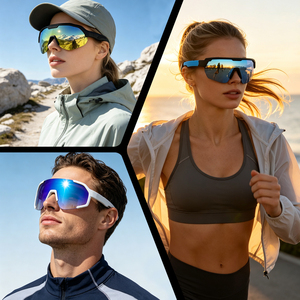
Beach volleyball, footvolley, and kitesurfing demand maximum optical wrap and UV protection against intense sand and water reflection. Embedded IPX4/IPX5 moisture sealing ensures sweat and salt spray do not damage interior micro-circuitry.
Endurance Cycling & Trail Running
Cyclists training in varying canopy conditions (such as Tijuca National Park or interior Serra da Mantiqueira) need lenses that shift transmission dynamically while keeping ears unblocked using open-ear air-conduction speakers for traffic safety.
Manufacturing Excellence
Why Top Optical Brands Partner With Our Factories
Our production ecosystem integrates Japanese optical-grade film lamination with advanced micro-electronics assembly. Unlike standard eyewear factories, our cleanroom manufacturing lines specialize in zero-delamination electrochromic bonding.
✓
Japanese Precision Optical StacksFilms laminated between impact-resistant optical polycarbonate for 100% shatterproof UV protection.
✓
Medical & Ergonomic ValidationOptics developed with consultation from sports medicine experts like Dr. Jay Schwartz (Phoenix Suns Team Doctor) to reduce ocular fatigue.
✓
Award-Winning EngineeringHonored by TIME's Best Inventions, CES Innovation Awards, and featured across Wired, Forbes, and Men's Health.
✓
Complete B2B Customization (OEM/ODM)Custom logo laser engraving, specialized VLT step tuning, Brazilian packaging compliance, and SDK app integration.
Clinical & Optical Endorsement
Validated by Team Doctor Dr. Jay Schwartz
"High-contrast optical tuning and instantaneous light control are critical for athlete reaction speeds. Traditional phototropic lenses take too long to adapt when moving between light and shadow. Electrochromic optical control gives athletes real-time vision optimization without optical distortion."
— Dr. Jay Schwartz, Team Doctor for Professional Basketball & Baseball Franchises
For Brazilian optical importers, retail buyers, and e-commerce brands looking to import smart transition sunglasses from certified factories, understanding regulatory pathways is essential for smooth customs clearance via Receita Federal.
1. Harmonized System & NCM Classification
Smart transition sunglasses featuring integrated Bluetooth audio hardware generally fall under double-attribute customs evaluation. The primary optical frame is classified under NCM 9004.10.00 (Óculos de sol - Sunglasses). When imported as a integrated smart electronic wearable, documentation must specify both optical protection standards and low-voltage electronic compliance.
2. ANATEL & INMETRO Certification Requirements
All active electronic sunglasses featuring Bluetooth 5.0+ RF modules sold in Brazil must comply with ANATEL (Agência Nacional de Telecomunicações) resolution requirements for short-range radiofrequency devices. Our factory supplies full Telecommunication Test Reports (FCC, CE-RED, RoHS) to accelerate local ANATEL homologation for OEM partners. Non-electronic pure electrochromic frames meet ISO 12312-1 and ANSI Z80.3 UV blocking benchmarks.
3. Tropicalized Packaging & Consumer Manuals
To comply with the Brazilian Consumer Defense Code (Código de Defesa do Consumidor - CDC), all wholesale shipments can be supplied with custom Portuguese-language user manuals, localized retail packaging, and magnetic charging accessories fitted with Brazilian standard power adapters.
Frequently Asked Questions
B2B Procurement & Technical FAQ
Direct answers for optical buyers, importers, and brand managers seeking transition sunglasses suppliers for Brazil.
How does electrochromic transition technology perform in Brazil’s hot climate compared to conventional photochromic lenses?
Conventional photochromic lenses rely on thermal-chemical reactions, meaning high temperatures in Brazil (above 30°C) cause the lenses to lose tint density. Electrochromic (EC) lenses use micro-voltage control to change ionic film alignment. They are completely immune to ambient heat, switching from clear to dark in under 0.1 seconds regardless of external temperatures.
What is the Minimum Order Quantity (MOQ) for OEM/ODM branding for the Brazilian market?
We offer flexible OEM/ODM tiers. Standard wholesale orders of ready-to-ship catalog models start at low MOQ (50–100 units). Custom branding (laser etched logos on frame/lenses, customized Portuguese packaging, and custom Bluetooth pairing names) typically starts at 500 units per model.
Can the lenses be fitted with prescription corrective optics (Aura Rx)?
Yes! Platforms such as Aura Rx feature a dual-layer frame design that holds prescription single vision, progressive, or reading lenses directly behind the active electrochromic film layer. Corrective power remains 100% stable while the tint transforms overhead.
How long does the battery last on electrochromic and audio smart sunglasses?
For tint-only electrochromic frames, power is consumed ONLY during the state change (switching tint). A single charge lasts several weeks or thousands of switches. For hybrid audio-tint models (like Music Shield Gen 2), continuous music playback lasts up to 6.5–8 hours, with 80% recharge achieved in just 80 minutes via magnetic fast charge.
What water-resistance ratings do these smart glasses carry for Brazilian outdoor use?
All smart electronic platforms carry IPX4 or IPX5 water-resistance ratings. Internal micro-circuitry is nano-coated to withstand heavy sweat, sudden rain showers, and humidity typical of tropical training or beach environments.
How do you support shipping, door-to-door delivery, and customs clearance into Brazil?
We partner with specialized air freight and sea freight forwarders experienced with Brazil customs (Receita Federal). We provide accurate commercial invoices, detailed packing lists with precise NCM codes, and certificate of origin documentation to streamline import tax handling (II, IPI, PIS/COFINS).
Partner With Our Factory
Scale Your Optical Business in Brazil with Next-Gen Smart Eyewear
Request our comprehensive 2026 B2B product catalog, full optical test sheets, wholesale price list, and OEM customization options. Speak directly with our B2B export specialists today.